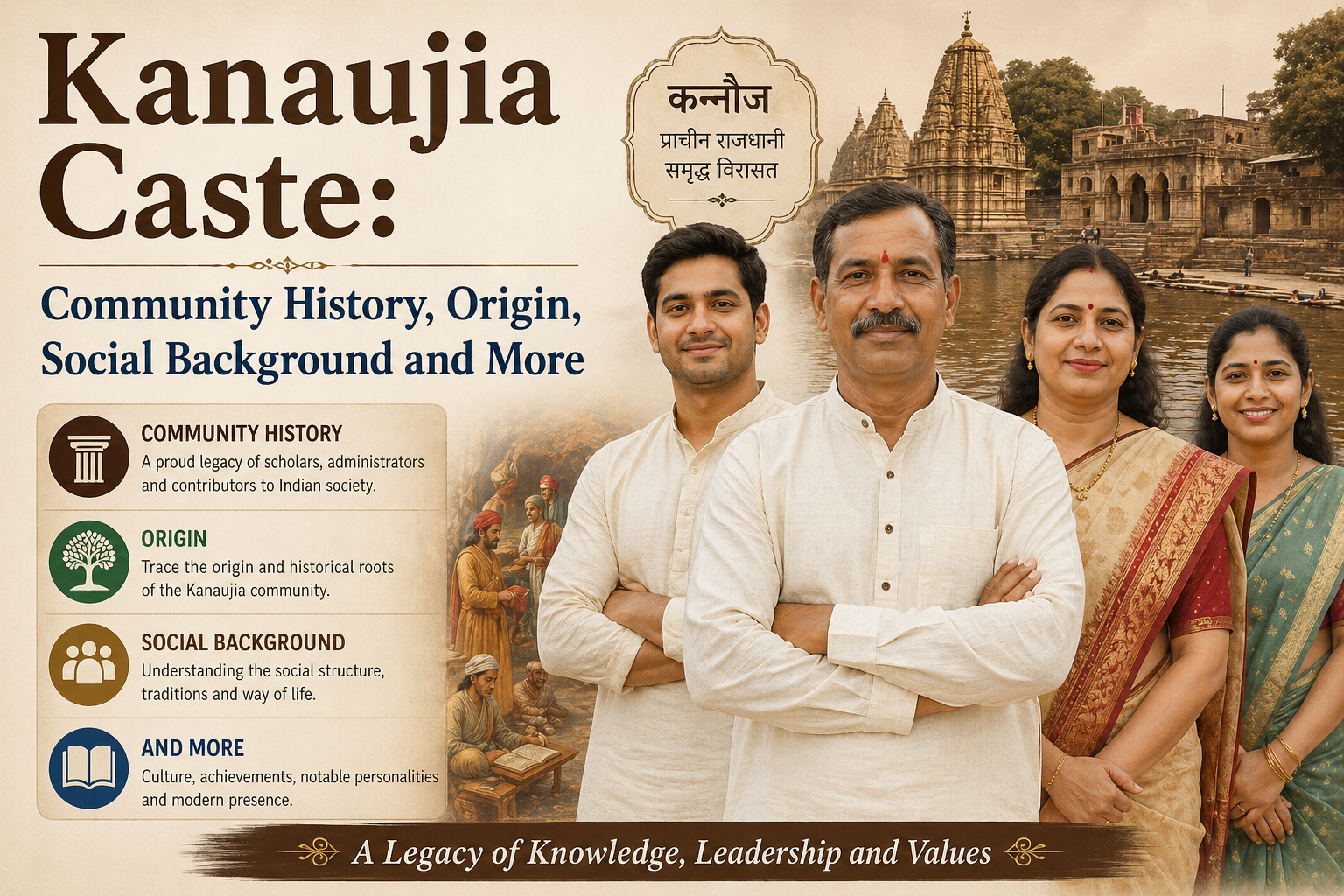
The names of the caste are Kanaujia is a reference to the origin of the community in the Kannauj region in Uttar Pradesh, India. They are mostly divided into Other Backward Classes (OBC) and Scheduled Castes (SC) in different areas of India. Kanaujia cast is subdivided into various categories, including Brahmins Rajputs, Brahmins, and functional subgroups such as Kanoija Sunar (goldsmith).
Because they originate from a particular place and refer to the location Kannuaj is a result. Therefore the surname, or sub-caste could be a part of many Hindu communities.
The most important facts about the Kanaujia caste!
History: The name originated from Kannauj. They are thought to be a part of Kanyakubja Brahmins that is a highly-ranked Brahmanical group. In the later years, a variety of occupational subgroups were created.
Categorization
- Kanyakubja Brahmin
In the past, people belonging to Kanaujia caste were at that time Kanaujia caste were teachers, priests or landowners. they lived in diverse states of India including Uttar Pradesh, Bihar, MP and Nepal. They were typically strictly vegetarians.
While some communities bearing the name Kanaujia are included in those of the OBC as well as SC classifications, occupations within this category were varied.
- Geographical regions
Kanaujia’s Caste can be found throughout North India, especially in Uttar Pradesh, Madhya Pradesh, Bihar, West Bengal as well as in different parts of Nepal, Mauritius, and other countries.
Communities that use the surname include:
- Bahmins
It is among the most well-known groups. It is part of the Pancha Gauda Brahmin communities of Northern India. In the past they were renowned as teachers as well as landowners or priests.
- Dhobis
Washermen are another group of people who employ the surname. While they were traditionally used to perform the task that involved washing the clothes today their identities have changed and they is active in various other areas as well.
- Sonars
It’s a subcaste within the goldsmiths who claim to have connection to those of the Suryavanshi Rajputs. They traded gold back then but their presence isn’t restricted to trading in gold, since they are found in various other fields too.
- Rajputs
They are recognized as a particular group of Rathore that share the same regional name.
Modern Context!
Today, Kanaujia is a group of people that came in Kanauj, Uttar Pradesh. They are now an established and wealthy community, working in a wide range of occupations. They are involved in the modern world of training, professional work and a modern lifestyle, working in a variety of roles, balancing traditional and modern.
- Modernization of culture
In the past, they were regarded in the past as Brahmins who had a the highest status. There are also subcategories which are classified in the form of Scheduled Caste or OBCs. But, contemporary Kanada caste Brahmins are highly educated, and are pursuing careers in the field as Priests, or Brahmins.
While at the same they didn’t forget their roots and are still retaining their duties as sacred rituals.
They adhere to strictly vegetarian diets as well as practicing monogamy. They are still working according to the same guidelines. Some have even abandoned their traditional ways.
Be aware that the subcategory of Kanaujia Brahmin is distinct than those of the Potters and washers groups that have the same surname.
- Influence of the political system
With a lot of power, they form an important political community with a significant political influence in UP.
End Note
In the end it is the Kanaujia identity is a mix of the high Brahmin caste, which has a an enviable status to a low particular community such as OBC as well as SC. However, in recent times, the terms have changed and the standard of living has reached the same levels as everyone is well-placed across all sectors.