
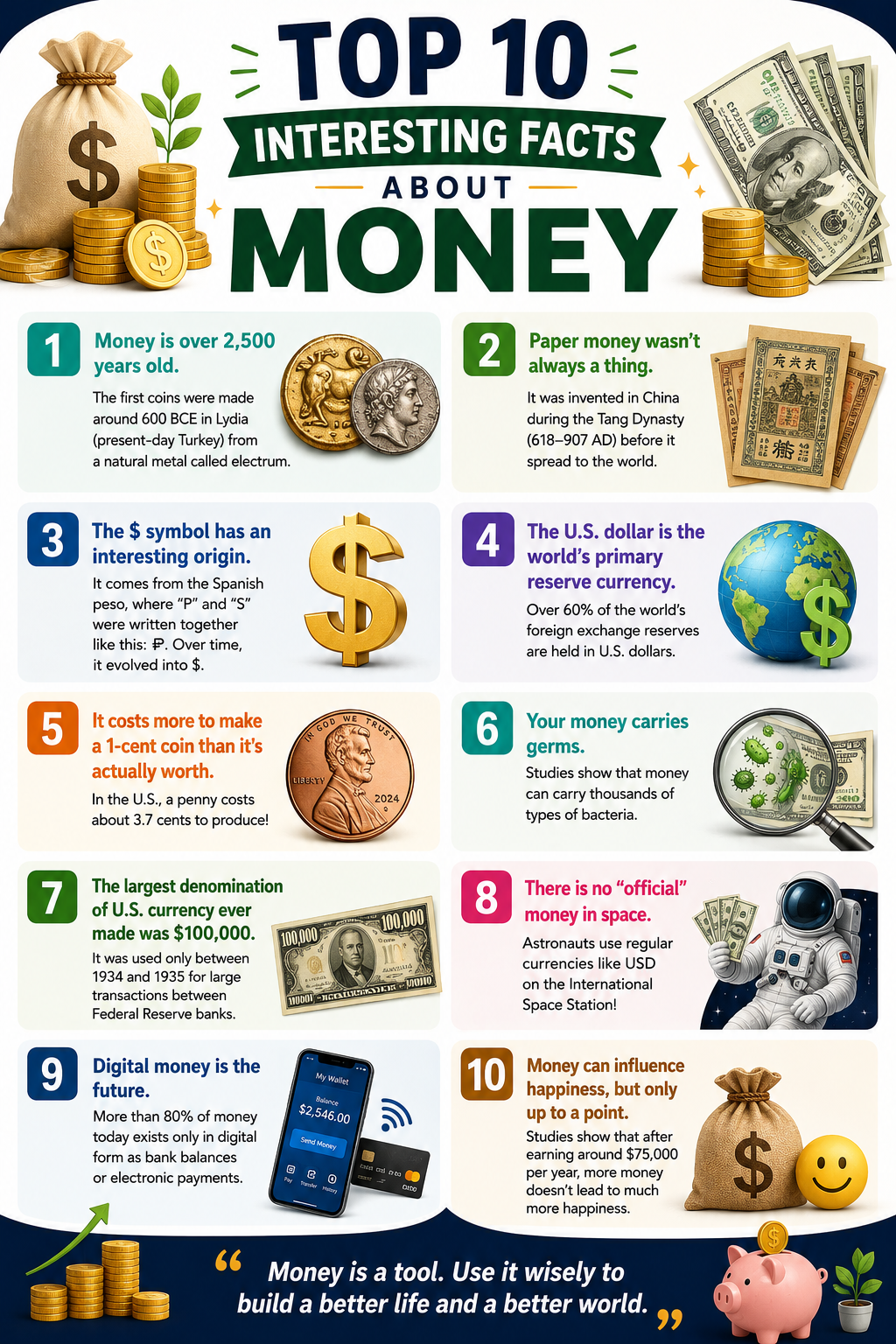
Money seems simple since we use it on a daily basis. It is earned, we invest it and save it, fret about it and then seek to get more. However, money isn’t as simple as it appears. It’s more than only paper, metal, or a display of numbers. Money is an idea that influences behavior, relationship, power and even fear, confidence and even your identity.
What makes money fascinating is the fact the fact that it’s not valuable in itself. The power of money is built on faith, trust and a collective consensus. All civilizations change on the basis of how money is made and controlled. It is also is understood. Understanding money isn’t just to be able to understand economics, but also to know the psychology of people and society. Check out the top 10 interesting facts about money, and find out how it affects our lives far beyond the banks and wallets.
Top 10 interesting facts about money
1. Money Has No Real Value on Its Own
It is not a thing that has intrinsic value. A banknote is nothing more than paper. Coins are just metal. Digital money is merely data.
It is only possible to make money if people are of the same mind that it is worth its value. This belief system is what allows savings, trade economic systems and trade to work. When trust fails the financial system also collapses. It has been proven time and again how when individuals lose confidence in the currency even massive amounts of money may be worthless in a matter of hours.
2. Money Was Invented to Solve Trust Problems
Prior to the advent of money was invented, people used barter to exchange goods in a direct exchange. This method failed when the needs weren’t in line.
The idea behind money was to create an impartial medium for everyone to be able to trust. Instead of trading shoes for rice the people exchanged rice for cash, and later using the money to purchase shoes later. In the end, money is a way to build trust and not wealth. It lets people from different countries work together with each other without having to know each other personally.
3. Most Money in the World Is Not Physical
The most surprising thing is that money is not cash.
Most money is electronically, in banks’ data bases, banking systems as well as online account. Cash in physical form is a tiny percentage of the total amount. That means that the majority of money today is an informational medium, not a thing. You “have” is usually just numbers that are supported by agreements and systems.
4. Your Brain Reacts to Money Like Survival
Psychologically, money activates those brain areas that are associated with survival and security.
This is the reason why the loss of money is painful, while the feeling of gaining it is rewarding. The brain believes that money symbolizes security, food, shelter as well as social status. This is why stress over finances creates anxiety, insomnia and emotional conflicts. The mind doesn’t perceive money as neutral, but instead considers it a fuel for survival.
5. More Money Does Not Equal More Happiness
Studies consistently show that money boosts happiness by a small amount.
After basic requirements and a reasonable level of comfort are satisfied Additional income is a loss of emotional benefits. Following that, aspects such as relationships, purpose as well as health and freedom have a greater impact. It can improve the quality of your life, but it can’t replace the importance of life. This is the reason many wealthy people are still feeling empty or overwhelmed.
6. Money Changes How People Think and Behave
When people are thinking about money their behavior shifts subtly.
Studies have shown how concentrating on the money could increase the independence of people as well as less compassionate or more competitive. It may reduce their desire to aid others. Money isn’t evil; it proves its power psychologically. Money isn’t just used to purchase things; it also alters your mental outlook.
7. Inflation Slowly Reduces Money’s Power
Value of money diminishes as time passes because of inflation.
What you could have bought for $100 or Rs100 a decade ago was a far cry than what you can buy the present. Inflation slowly reduces the purchasing power, even if prices are rising slow. This is the reason why securing money without growing could be a loss of value. The value of money is never static. It continuously fluctuates in value.
8. Debt Is Older Than Money Itself
Debt existed prior to the invention of banknotes and coins.
Early societies maintained documents of who owed whom usually in the form of grains or in labor. The power structure of debt shaped the way people governed social classes, as well as even laws. Even today, our modern economies depend heavily on credit. The problem with debt is that it is a system, but it has to be controlled carefully since it boosts both growth and the possibility of collapse.
9. Money Reflects Values, Not Just Numbers
The way people spend their money shows the priorities of their spending more clearly than any words.
The way we spend money reflects what society values: education as well as luxury, defense entertainment, health. On the individual level, your spending habits reflect attitudes about fears, desires, and beliefs. The way you spend money doesn’t alter your character in the same way as it reveals it. It is a way to highlight what’s important to anyone.
10. Money Is a Tool, Not a Goal
The most significant fact regarding money may also be the most simple it is that money is intended to be used and not to be worshipped.
Money is most effective when it is a source of security, growth, liberty, generosity and stability. When it becomes the end goal instead of an instrument and instrument, it can cause anxiety, greed and instability. Money-related relationships that are healthy are based on clarity not over-simpleness.
Conclusion
Money is among humanity’s most powerful inventions. It’s not just because of its value however, but for the meaning it carries. It ties reward to effort the trust of exchange and the survival of society. But money itself isn’t neutral. It is shaped by the motives and values behind it.
The concept of understanding money doesn’t mean you should chase the same amount. It’s about understanding the way it functions and how it impacts the mind and how best to utilize the power of money without letting it rule your the course of your life. When money is put in the correct position–as an employee, not an owner–it can become a formidable allies instead of being a constant cause of anxiety.