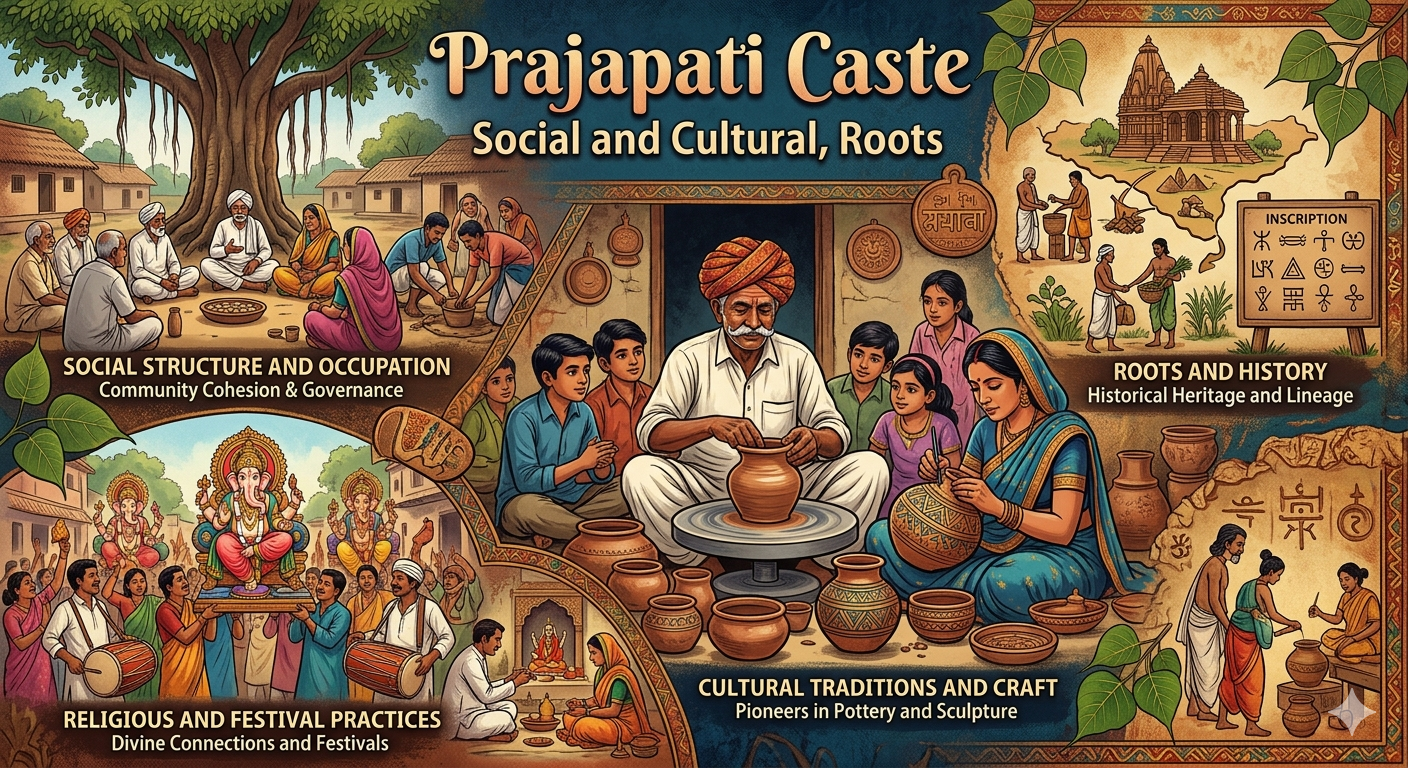
There is a Prajapati caste is referred to as Kumhar. It is a renowned Hindu community of artisans that is spread all over India as well as being classified within the OBC. It is a traditional artisanal caste that is linked to occupations such as sculpture or pottery. Their work has been traditionally pottery which aids in making idols as well as other household objects.
Prajapati is a name that has the meaning “Lord of creatures”, which is a reference to the god of creation according to Hindu texts. Prajapati can be found in a variety of Gotras including Gautam, Kashyap, Atri, Bharadwaj and Vishwakarma.
Learn about the influence of culture and society.
They practice Hinduism as well as they worship Hinduism, and their Kuldevi (ancestral goddess) is known as Shriyade Mata. One of the important rituals the Prajapati caste observes includes the Chaak Puja during wedding ceremonies, when the groom’s family gathers at the house of the potter to pray for the wheel of the potter to mark the beginning of a new chapter in life.
What do the origins and mythology have to say?
- Lord Brahma’s blessings
According to one legend, Brahma has been awarded the title “Prajapati” to a potter who was extremely dedicated to his work. So much which is why he once failed to consume the Sugarcane which Brahma granted him.
- Subcastes or groups
The caste has been split into different groups, such as Ajmeri, Maru and Khambati in Gujarat There is also an additional caste called Kannaujia located in Bihar as well as Uttar Pradesh. In addition to the term Prajapati they are often referred to by the names of Kumbhar, Kumawat, Kulala and Ghumiyar.
- The occupational roots
Their main occupation was pottery and sculpture that includes five major elements. These are: water, earth air, fire, and space, which aid in the making of household objects.
- Contemporary social, legal and political classification
In the present Indian reservation system the community has been classed as Others Backward Classes (OBC). In a majority of states, including Madhya Pradesh, Rajasthan, Gujarat and Odisha the caste is classified as OBC in the main list of OBCs.
There are also regions such as Uttar Pradesh where the Prajapati caste is now on the SC list in order to address the social and economic disparities that have existed for a long time. ‘
Subgroups and regional distribution!
The community is classified in various subgroups, based on the region.
- In Rajasthan Subgroups of Rajasthan include Marwara, Timria, Kheteri, Mathera and Mawalia.
- In Gujarat group names include Gurjar, Varia, Mistry and Vatalia.
- Punjab The cast of Punjab was referred to by the name of Bagri and Maru Kumhars. In the sense of their occupation, a lot of them have moved from agriculture to pottery as well as various other professions.
- In Maharashtra They are also known as Maratha Kumbhars. They are prominent in several districts in Maharashtra which are called Pune, Satara or Kolhapur.
The evolution from the Prajapati caste!
- Today today, the Prajapati Caste is aplenty across India particularly in several states such as Gujarat, Uttar Pradesh, Bihar and Rajasthan.
- Although some people remain in the field of pottery, others have switched to other careers after they have completed their studies. There are members of the community everywhere, from government agencies to private businesses.
- The caste does not just work to protect its rich heritage of craftsmanship, but it also develops in line with the changing times of India.
Conclusion!
In the beginning, the Prajapati caste was a part of the art of creation, artistic talent and spirituality. They create a lot of household objects, however nowadays, they are found in many other sectors